
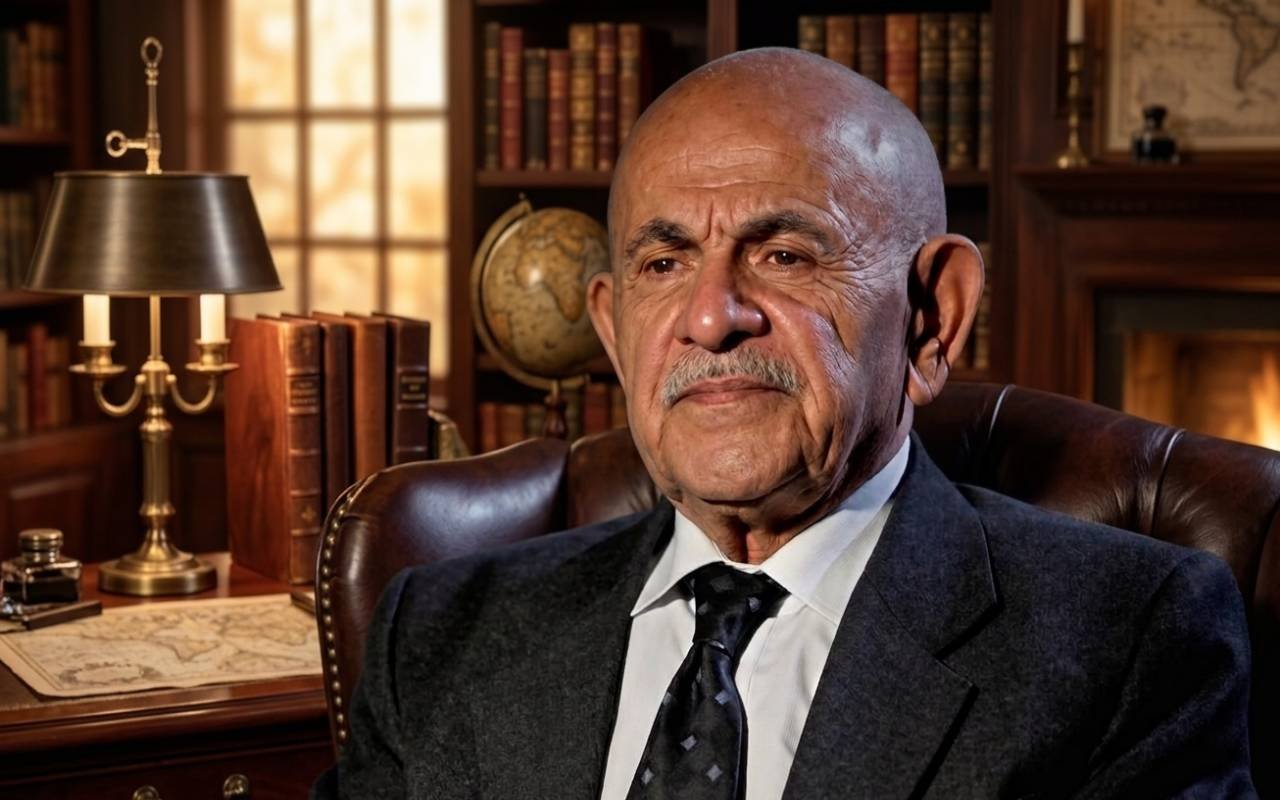

Mustafa Ibrahim Amin Zalmi is one of the most prominent Kurdish Islamic scholars and thinkers in the modern era. He was born in the village of Zalmi in the district of Khurmal in the Halabja region of the Kurdistan Region of Iraq. Official records indicate that he was born in 1924, while some local accounts say that he was born in He grew up in a classical religious environment, and this climate had a great influence on his scientific structure early in life, as he had the opportunity to study religion from an early age.
Zalmi began his studies in Kurdistan's religious classes and studied basic religious and linguistic sciences such as grammar, usage, psychology and logic, along with jurisprudence and its principles, as well as deepening in the study of philosophy and some intellectual sciences. He studied under a number of great Kurdish scholars, including Mullah Arif Ber, Mullah Baqir Balk, Mullah Hama Amin, Mullah Abdulkarim Muderis and many others. After years of study, he received his license in 1946, a common qualification at the time that allowed him to teach and issue fatwas.
After receiving his license, Zalmi began teaching in mosques and religious schools, teaching students Shari'ah and linguistics, and continued in this field until During that time he served as a preacher and orator in the Iraqi army until 1972, which gave him the opportunity to have direct contact with different sections of society.
Zalmi did not stop studying in the room, but turned to new academic studies, participated in external examinations and completed primary and secondary schools, then in 1959 successfully completed high school in Baghdad. In 1960, he entered the College of Law at Baghdad University and in 1965 obtained a bachelor's degree in law. He then continued his higher education and received a master's degree in Islamic law from Baghdad University in 1969, then a master's degree in comparative jurisprudence from Al-Azhar University in 1971 and another master's degree in law from Cairo University in.
In 1975, he received an honorary doctorate in comparative jurisprudence from Al-Azhar University, one of the highest academic degrees he has achieved in his field of specialization. After many years of academic work, in 2005 he obtained another doctorate in law from Baghdad University with honors, indicating his continuity in scientific research and self-development until the final stages of his life.
Zalmi began teaching at the university in 1976 and continued until 2008. He crossed scientific degrees until he earned the title of Professional Teacher (P). During this time, he supervised more than 100 master's and doctoral theses in the fields of Sharia, law and philosophy and contributed to the education of a generation of researchers and scholars.
He has written more than forty scientific papers on various topics of jurisprudence, principles, law and philosophy, including social development in Islamic law, principles of legitimacy, principles of criminal responsibility, principles of personalization of crime, spiritual energy and civilization In Islam, Islamic legislation, notes on Iraqi personal status law, treatment of human genetics in sharia and law, relationship between sharia and law, and sharia and legal classification of different processes.
In addition to these researches, Zalmi has written a large number of books in various fields, his works were published in a large collection called (Complete in Sharia and Law) in 2014, which contains fifty books and is divided into twenty-four volumes. This collection covers a wide range of topics such as the principles of jurisprudence, reasons for the differences of jurist, references to texts, theory of compliance, criminal responsibility, philosophy of law, personal status, marriage and divorce laws.
Zalmi was distinguished by his critical thinking, as he did not stop at taking the opinions of previous scholars but discussed them, criticized them, and revised them according to a scientific method that relied on legitimate and rational evidence. He called for the renewal of Islamic jurisprudence to keep pace with contemporary developments, emphasizing that it must be new and vibrant and responsive to contemporary social and legal challenges.
He was also known for expressing his views boldly, discussing sensitive issues and providing new ijtihad in them, based on a deep understanding of Shari'ah texts and their intentions. He believed that ijtihad was necessary to renew religious thought, and that blind imitation would lead to the stagnation of thought and the backwardness of societies.
Zalmi has participated in a number of legal and constitutional committees, discussing bills and revising some laws, such as the Iraqi Civil Code, the Principles of Criminal Procedure Law and the Iraqi Constitution. He has also participated in a number of scientific conferences inside and outside Iraq, including the Conference of Sociologists, Legal and Medical Conferences, and Conferences on Human Rights.
Zalmi has received several awards and honors in recognition of his scientific work, including the Baghdad University Outstanding Teacher Award in 1985, the Presidential Outstanding Teacher Award in 1993, the Scientific Product Award in 1993, and a Nahrin University Award in He was also awarded an honorary doctorate from Salahaddin University in Erbil in 2015 in recognition of his scientific efforts.
On a personal level, Zalmi was known for his earthiness and simplicity, closeness to his students and the common people, distinguished by his love of science and his zeal to disseminate knowledge. He also had his own independent opinions, because he did not follow any political or religious party, but maintained his opinions and positions even when faced with criticism.
His personality was known for his scholarly commitment and thoroughness in research, his reliance on scientific research and verification of sources, and his concern for providing thorough and in-depth evidence-based research. He combined religious authenticity and openness to new thought in his personality, which made him a unique example of contemporary Kurdish Islamic thought.
Mustafa Ibrahim Amin Zalmi passed away on Saturday, June 4, 2016 in Erbil, at the age of ninety-one, leaving behind a great scientific and intellectual legacy consisting of writings, research and opinions that are still a rich material for study and research.
Mustafa Zalmi's personality was characterized by a number of intellectual and scientific characteristics that distinguished him from other scholars, above all his critical consciousness, because he combined between the depth of cultural structure and openness to new research. This awareness made him present in the scientific field and participate in intellectual and jurisprudence discussions, inside and outside the universities.
He also had a clear rational vision, reflected in his advocacy for reform of religious discourse and the elimination of transmitted interpretations that do not rely on sound evidence or common sense. Hence his constant advocacy of ijtihad and rejection of rigidity came into play since human jurisprudence needs permanent revision.
Another of his most prominent characteristics was his advocacy of moderation, as he worked to consolidate the values of coexistence and tolerance among the communities of society, and emphasized that Islam demanded mercy and justice, and protected human rights regardless of identity. She was also one of the defenders of women's rights, especially on some jurisprudence issues that she addressed with a new perspective.
Innovation is considered one of the most important dimensions of his personality, because he tried to free jurisprudence from classical and closed religious stagnation, based on the basic principles of Shari'ah and its great purposes. He revised many jurisprudence views and offered new ijtihad to suit contemporary circumstances, and sought to develop the science of the principles of jurisprudence in new ways and arrangements.
He was also known for his great scientific commitment because he relied on careful examination of evidence, was anxious to verify his sources, and provided research on a solid scientific basis. He was known for his careful documentation and attention to detail, which made his work of great scholarly value.
Among the distinctive characteristics of his personality was his independence of thought and attitude, for he did not follow any political or religious party, but maintained his own views, even if they were contrary to the prevailing trend. He was known to be uncompromising on scientific issues, and to stick to what he thought was right.
He was also known for his bold presentation of opinions, as he discussed sensitive issues and offered bold ijtihad, such as some of his opinions on contemporary jurisprudence issues.
With regard to identity, Zalmi was a representative example of the fusion of Kurdish and Islamic identity, because he combined Kurdish nationalism with his own Islamism, and tried to find a framework of balance and moderation between them. With this vision, he contributed to the enrichment of Islamic thought, while preserving the uniqueness of his national cause, and demanded cultural and religious rights within the framework of justice and humanity.
Together, these characteristics formed the character of a unique scientific and intellectual personality, which made Mustafa Zalmi one of the most prominent symbols of contemporary Kurdish Islamic thought.