
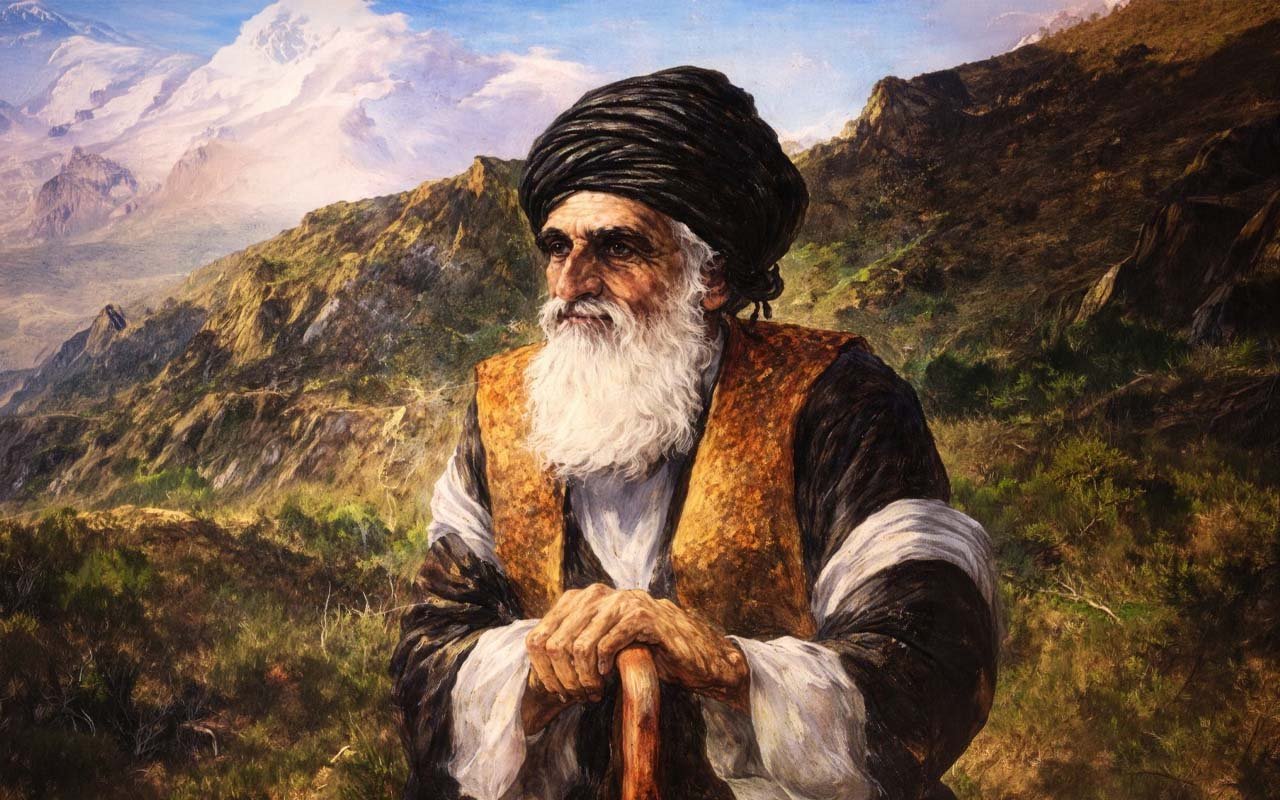

Life of Mawlawi
His full name is Sayyid Abdur Rahimi son of Mullah Saeed and his ancestry goes back to the great religious scholar of Kurdistan and the Islamic world (Mullah Abubakr Musannifi Chori) who also goes back to the famous theologian and religious scholar Sayyid Mohammad Zahid. Sayyid Abdur Rahim, popularly known as Rumi and in poetry as Ma'doom or Ma'doomi, was born in 1221 AH (1806 AD) in the village of Sarshata in the Tawgozi region in a religious family He went to several Kurdish cities and regions such as Sulaimani, Halabja, Jawanro and Sanaa to continue his studies. He was also given permission to become the caliph of the Naqshbandi sect, one of the most well-known sects of Sufism, by Sheikh Othman Sirajuddin I.
Mawlawi was a very intelligent and highly respected scholar and was very popular among the people. He was able to open the blind knots of life and save people from social problems and chaos. When Rumi made a decisive decision, both sides remained silent because his words and fatwas were the conclusion of the words and arguments of his time. .
Works of Mawlawi
In addition to his divan, which is written from Goran's perspective, Mawlawi has several works, some of which we know the names of, and he wrote them in Lower Kurdish, Arabic and Persian. We do not know the names of others because they became food for fire in an accident caused by the burning of his library. The works of Rumi that we know the names of and most of them have been published are (4):
- “The Pathological Creed” is written in the Lower Kurmanji dialect, in the speech style of the people of the Tawgozi region. It consists of more than two thousand lines of poetry. The book was written in light of the Ashʿari creed and discusses the foundations and branches of the Islamic religion. It also includes some secondary topics related to Islamic theology (ʿIlm al-Kalām).
- Al-Fadhilah is a book on the principles of Islam, written by Mawlawi in a very high level Arabic language and consists of 2031 verses of poetry.
- Al-Fawaih, written in Persian, is about Muslim beliefs.
- This unpublished book is said to have been available in the monastery of Biara until the lifetime of Sheikh Najmaddin Naqshbandi. It contained many useful things, but it has not reached us.
- Zubda al-Aqeedah, which is about the belief in Islam, focuses on the unity of God and His attributes.
- He wrote a pamphlet on the truthfulness of al-Rabta in Persian, which is one of the followers of the Naqshbandi movement.
- Aqeedah al-Mawlawy, a booklet of 110 verses of poetry written in Lower Kurdish, is similar to the spirit of al-Aqeedah al-Marziyah in terms of dialect and style, but very simple Marzi's doctrine, which is written in a special way and requires a well-educated mullah to understand. This booklet of Rumi was published in 2024 under the title (Kurdish Doctrine in Brief) (5).
After a life of poverty and pride, Mawlawi died in 1300 AH and was buried in the cemetery of the Companions at the foot of his village.
sources and margins
- This article is the beginning of an extensive study written under another title. .
- Mullah Abdul Karimi Modarres, 1999, Diwani Maulavi, Sanandaj: Kurdistan Publishing House, p.
- Azad Abdulwahid, 1997, A New Document, on the Creed of the Caliphate (Maulawi), No. (14), August 25, p.
- Mohammad Amin Habib, 1989, A Journey to the Horizon of Rumi's Imagination, Rumi's Festival, Book No. 1 of Roshnbiri Nui Magazine, 1988, p.
- Ayub Kuekha Rostam, 2016, Mawlawi and the Art of Poetry is an Objective Study, pp. 34-3.
- Abdurrahimi Maulavi Tawgozi, 2024, Kurdish Doctrine in Brief, Discovered and Proven by: Mohammad Ali Karadakhi, Prepared by: Adel Latif Maulavi, First Scientific and International Conference on Maulavi Studies, pp. 3-5.
- Mullah Abdul Karimi Modarres, 1999, Diwani Maulavi, Sanandaj: Kurdistan Publishing House, p.