
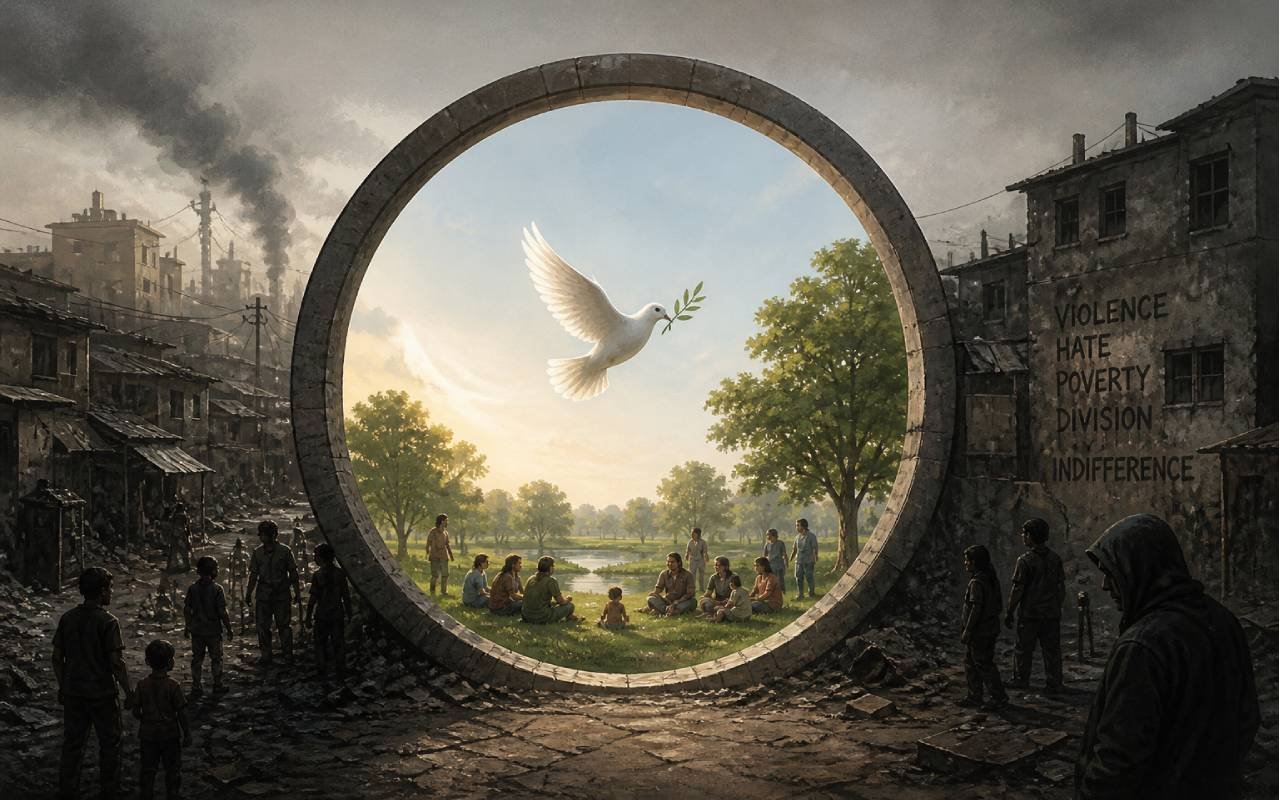

The achievement of world peace has become one of the highest human goals that all societies hope for in the shadow of the modern world system. Peace is portrayed as a natural outcome of the development of societies and the transition of stages of conflict, as if it were only a matter of time or will.
However, this notion, despite its prevalence, may be as misleading as it is reassuring. For the world in which we seek peace is not based on a neutral or balanced system, but a space in which conflicts and forms of instability regularly emerge.
Hence, it appears that the subject of “launching efforts to achieve peace”, despite its appeal, overlooks a more complex structure that governs contemporary reality. Because there is no longer a position on the basic conditions that lead to peace, such as: balance of interests, social justice and the existence of an institution capable of managing conflicts. Therefore, in the absence of these conditions, peace remains more of a pending idea than a stable and established situation.
The apparent absence of conflict is not enough to say that peace has been achieved. We must not be deceived by scenes of peace and quiet, while within the fringes of communities a variety of less visible but more profound and affecting imbalances persist; such as oppression, marginalization and injustice, to the persistence of class differences and the growth of extremist thought in all its repressive forms. These phenomena do not disappear, but hide like splinters under the ashes, making peace talk much more complex than it appears, and resulting in an idea and meaningful concept that is used more than it is realized.
Thus, the deepest aspect of the world's peace problem is revealed, which lies in the deep gap between discourse and reality, with the lack of a common ground between the parties from which to start to reshape the social frameworks leading to conflict. These are situations whose outcomes are governed within a historical set of rules and traditions, most often based on fundamental differences in perspectives and interests.
Hence, the problem is not the “difficulty of achieving peace”, but that peace is absolutely impossible. The first step on the way to reconciliation with this reality is to no longer ask the question “How do we get to peace?”. Let’s not, but switch to a more complex question: “How do we deal with the fact that tension is not an emergency, but an integral part of the very structure of this world?”.
Hence, peace, as an open path, requires a multiplied effort to maintain a delicate balance between the forces that relentlessly reproduce conflict. But the idea of absolute peace is more like a utopian description, which is difficult to achieve because of social and international imbalances – both visible and hidden – and because of the conflict of interests between different classes.
Will peace as a concept finally become a veil that hides the complexity of reality, or will we face the fact that peace was never what we were used to portraying?
Translated from Arabic
Amez Khasraw Qadir